
Popular search:福尔摩斯:基本演绎法第一季支付宝蒙面唱将猜猜猜琅琊榜长城
幻夜
Toaster Starring Rajkummar Rao And Sanya Malhotra Set For Mid-April Release_我的网站

一 | Netflix has officially announced its upcoming original film, Toaster, a dark comedy based on the unexpected chaos after a cancelled wedding. Directed by Vivek Das Chaudhary, the film is scheduled to premiere on the streaming platform on April 15, 2026. The story explores a situation where a wedding is called off after gifts have already been exchanged. The plot begins with a petty fixation on a specific gift, a toaster, and follows a simple miser (Rajkummar Rao) as his pursuit to recover the item leads to ridiculous and escalating chaos and drama. The film marks a professional milestone for Patralekhaa, as it is the first production under her and Rajkummar Rao’s banner, Kampa Film. The project stars Rajkummar Rao and Sanya Malhotra, supported by an ensemble including Archana Puran Singh, Abhishek Banerjee, Farah Khan, Upendra Limaye, Vinod Rawat, Jitendra Joshi, and Seema Pahwa. About the production, Patralekhaa, producer of Kampa Film, said, “Stepping into production with Kampa Film has been an incredibly meaningful milestone for us, and beginning this journey with Netflix, who have consistently championed distinctive and unconventional stories makes it even more special. Toaster immediately stood out because it finds humour in the most unexpected places, and the moment we read it, we knew it was a story we wanted to bring to life.” View this post on Instagram A post shared by Netflix India (@netflix_in) Ruchikaa Kapoor Sheikh, Director of Original Films, Netflix India, mentioned that the film aligns with the platform's focus on inventive storytelling and emerging talent. She said, “Toaster is a quirky dark comedy that begins with a simple miser whose life spirals into complete mayhem in pursuit of getting back his toaster. It’s the kind of inventive storytelling we love to champion at Netflix. With Vivek Das Chaudhary making his directorial debut and Patralekhaa & Raj stepping into the producer’s role for the first time with Kampa Film, the project reflects our continued focus on championing emerging talent behind the camera while bringing an exciting burst of fresh creative energy.” The film's story and screenplay are credited to Parveez Shaikh, with Akshat Ghildial and Anagh Mukerjee also serving as screenwriters. Akshat Ghildial has also penned the dialogues. Toaster will be available for streaming on Netflix from April 15.Also Read: Toaster Teaser: Rajkummar Rao and Sanya Malhotra promise chaos and laughs。
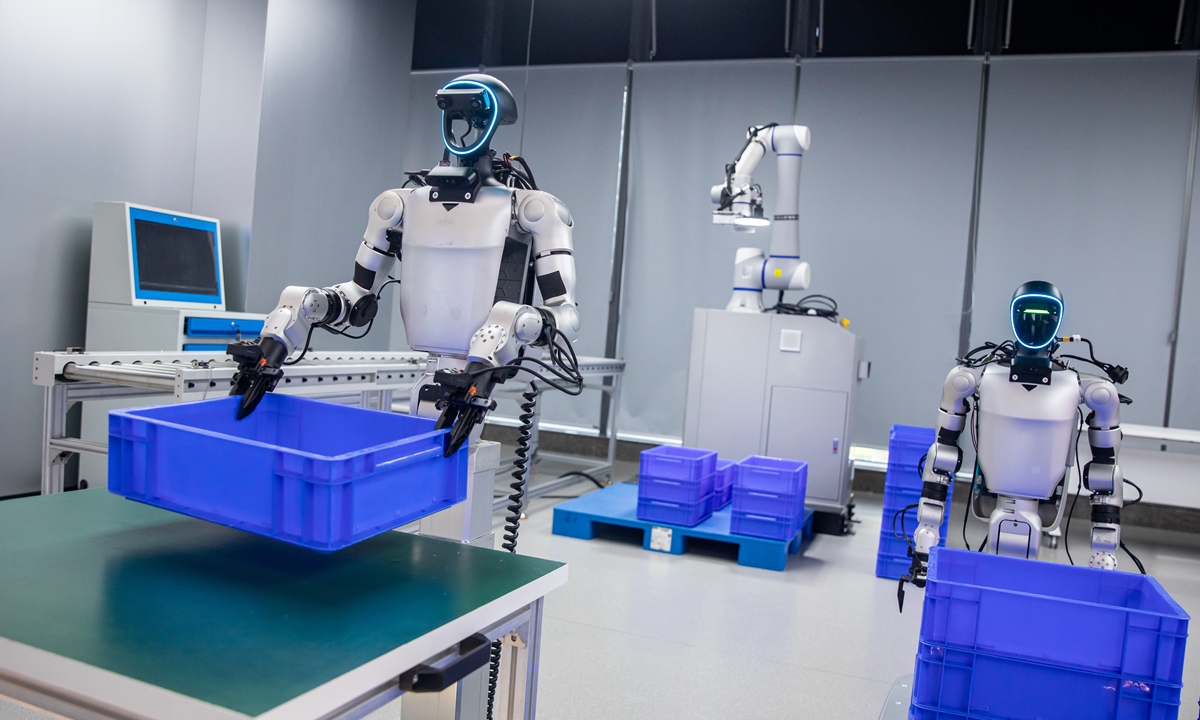
Consumer-oriented embodied AI model developer Noin Intelligence announced a 500-million-yuan ($74.1 million) Angel++ funding round on Monday, the company said in a statement, marking another major capital inflow into embodied AI models as investors turn their attention toward the "brains" behind robots.
According to the statement, the company plans to channel the funding into developing more generalizable embodied AI models, advancing iterations of its GLOW generative model, and accelerating product validation and mass production.
Industry experts noted that a broader shift in the robotics race, with competition moving beyond hardware performance toward the development of core intelligence capabilities. While hardware forms the physical foundation of robots, embodied AI models determine their ability to perceive, learn, reason and adapt in real-world environments, making them a key factor in unlocking future opportunities.
The funding momentum extends beyond Noin Intelligence, with several other companies recently securing major financing rounds that are largely focused on advancing their AI models.
On August 3, Wuxi-based embodied intelligence company DISCOVER Robotics secured a $100 million Angel+ funding round, shortly after completing its initial angel financing of more than $100 million, according to Wuxi Fabu, the official WeChat account of the local government.
The company later introduced ORION, a hierarchical embodied intelligence foundation model, as well as LOOP, a virtual-real hybrid data closed-loop system, and DISCOVERSE, a high-fidelity simulator. The solutions are designed to tackle two major challenges facing the embodied intelligence — data scarcity and limited generalization — and accelerate the development of more capable AI systems, according to Wuxi Fabu.
In addition, according to industry media reports on August 3, Ant Lingbo, Ant Group's embodied intelligence subsidiary, has launched its first round of financing, seeking to raise 1.5 billion yuan.
The company aims to complete a second funding round by the end of this year. The company later confirmed to media that it was in discussions with investors, saying that as a core initiative of Ant Group's embodied intelligence strategy, it will continue to focus on developing general-purpose robotic brains, increase investment in embodied-native technology pathways, and accelerate industrial deployment.
The shift is also reflected in the fundraising priorities of publicly listed candidates.
Notably, Unitree Robotics, which has recently drawn widespread attention from the capital market, officially opened IPO subscriptions on Monday. According to its prospectus registration document disclosed by the Shanghai Stock Exchange on June 2, the company plans to raise 4.202 billion yuan through the IPO, with nearly half of the proceeds earmarked for its intelligent robot model R&D project.
Of the total proceeds, 2.02 billion yuan will be allocated to the intelligent robot model development project, significantly exceeding the 1.11 billion yuan planned for robot body R&D, highlighting the company's focus on developing the AI capabilities that power robots.
Wang Peng, an associate research fellow at the Beijing Academy of Social Sciences, said the latest financing trend shows that capital is reassessing where the core value of robotics lies. Investors are increasingly moving beyond robot hardware itself and treating embodied AI models and robotic "brains" as high-value assets, with capital flowing more toward software, algorithms and intelligence capabilities, he told the Global Times on Monday.
The valuation framework is also being reshaped, with investors paying greater attention to real-world deployment, customer adoption and repeat demand rather than hardware specifications or corporate narratives alone. Whether robots can operate reliably in real application scenarios has become a key benchmark for investment decisions, Wang said.
He added that increased investment in embodied AI models and generative world models could help address the structural gap between general-purpose AI models and physical-world interaction by expanding the supply of real-world interaction data. Capital is also increasingly favoring companies aligned with the country's long-term industrial priorities and emerging industry development plans, he said.
According to data from IT industry research platform ITjuzi.com, financing in China's embodied intelligence sector totaled 93.5 billion yuan in the first half of 2026, surpassing 90 billion yuan and marking a fivefold increase from the same period in 2025. The number of financing deals reached 322, up 137 percent year-on-year.
As China enters the first year of its 15th Five-Year Plan period (2026-30), policy priorities are placing greater emphasis on developing emerging industries, with the country accelerating AI development and promoting its integration with various sectors, Chinese experts noted. Meanwhile, as global AI development enters a new stage driven by broader applications and deeper industry integration, embodied intelligence is expected to unlock significant growth potential.
Driven by policy support and rapid industry evolution, the nation's upstream and downstream segments of the AI industry have gained momentum, achieving notable progress.
According to a Bloomberg's Monday report, China's humanoid robot makers commanded more than 97 percent of global shipments in the first half of 2026, according to new industry data affirming the country's early lead against US rivals in the burgeoning field.
Meanwhile, global humanoid robot shipments totaled roughly 19,100 units in the first half of 2026, more than triple the 5,100 units shipped in the same period last year, according to data from Smart Analytics Global. Data further noted the California-based research firm expects shipments to rise to around 60,000 units this year and reach half a million by 2030.
。
Current article:http://lgos9.shangfochengcongshuaizhuang.buzz/h6a/bsk.html
Published on:02:58:19
老千_Random reading
- 08-23Relevo:巴尔韦德在皇马更衣室备受赞赏,球员带伤坚持了多场比赛
- 08-26官方完整视频:张小龙4小时微信公开课
- 08-24美国悬赏1000万美元征集5名伊朗武装力量高官线索,包括革命卫队总司令、武装部队总参谋长、革命卫队无人机司令部司令等
- 08-21华硕罗格追光旗舰长椅123:6核i9/rtx 2080,售价39999元
- 08-26世界上最昂贵的离婚案即将诞生:贝索斯有了妻子,或者成为世界上最富有的女人。
- 08-21Exclusive: Bobby Deol Talks About The Similarities He Shares With His Father Dharmendra
- 08-23加息突变!美联储发出重大警告
- 08-26VLC播放器确认Apple AirPlay将被带到Windows 10
- 08-26一女子肚子痛十多天,医生从肠子里揪出一条活虫,“还在动”!“元凶”很多人爱吃
- 08-21Chinese FM spokesperson responds to judicial proceedings of two Japanese nationals detained in Dalian

恐怖游轮_Active users
- C919 completes first scheduled international commercial service
- International market remains key growth driver for China's air cargo
- 扣篮界的黑八!陈登星凭借飞人臀下换手坐扣 淘汰NBA扣篮王麦克朗
- 活力中国调研行|走进坊茨小镇,看工业遗存焕发新生
- 【观点】南华期货:焦煤、焦炭高位震荡
- Best Korean Movies on OTT: A Streaming Guide to The Finest Cinema From South Korea
- 联想Z5 Pro GT 855版北京东延:1月29日正式开业
- 多个站口禁止车辆上道!河北高速最新路况
- 转会费近3000万!记者:吉达联合前锋穆萨·迪亚比即将加盟药厂
- 美国计划让因伊朗战事撤离中东的外交官返岗
- 里奇·保罗:热火的体系能让克莱事半功倍 他只需要安心把球投进
- China advances global AI governance on all fronts, turning principles into deeper, more concrete action
- 罗马诺:明特转会利物浦谈判没有进展,过去24小时交易冷却
- Kartik Aaryan Shares Emotional Haldi Video From Sister Kritika Tiwari’s Haldi
- 戴尔G7光碟追逐笔记本京东订房:第8代i7 RTX 20614999元
- 情节严重!造谣“分析师孙潇雅因吹票被罚8亿元”,38岁男子被警方行拘7天
- 80岁西班牙“狼孩”去世,被狼群抚养12年,曾说重返人类社会最可怕,试图回到狼群却不被接纳;以其为原型的故事被拍摄成电影《与狼共伍》
- 中国第一个3D打印生物标本:世界上最后一只白海豚的完美复制
爸爸去哪儿_Hottest this week
- 08-23Steam喜欢免费给“叔叔传奇”HB店加1:42元。
- 08-21China's Pingyao International Photography Festival draws nearly 20,000 works from over 2,600 photographers
- 08-25弹指六年,奥斯塔彭科竟是唯一能全场地胜斯瓦泰克选手
- 08-20四川电信邀请大众高清电话
- 08-26【现货】8月26日各地区国产大豆价格汇总
- 08-20哥伦布机员主帅:我们对梅西限制得不错 裁判应该用黄牌控制局面
- 08-20【异动】苯乙烯一看空商品期权合约大涨124%
- 08-20翻江倒海!申京上半场13中8得16分7板1助 开场就送炸扣
- 幻夜 copyright
- Some of the content comes from the Internet. If you have any offence, please raise it.