
霍去病
US urging China and others to back Iran sanctions an attempt to ‘shift blame for own failed pressure campaign’_我的网站

A | Veteran actor Amitabh Bachchan mourned the loss of his dear friend and legendary actor, Dharmendra. The latter breathed his last at the age of 89 after suffering from health-related issues. He was cremated at the Pawan Hans Crematorium on November 24 and several celebrities, including Amitabh Bachchan and his Abhishek Bachchan had come to pay their last respects. Dharmendra's Sholay co-star penned an emotional note on his blog and recalled their bond. Big B shared, "...another valiant Giant has left us .. left the arena .. leaving behind a silence with an unbearable sound ..Dharamji .. the epitome of greatness, ever linked not only for his renowned physical presence, but for the largeness of his heart, and its most endearing simplicity. He brought with him the earthiness of the village in Punjab he came from, and remained true to its temperament un soiled throughout his glorious career, in a fraternity that witnessed changes every decade .. ...the fraternity underwent changes .. not him." He concluded by writing, “His smile, his charm and his warmth, extending to all that came in his vicinity .. a rarity in the profession, the air about us swings vacant, a vacuum that shall ever remain vacuus..prayers." Amitabh Bachchan and Dharmendra shared the screen in several films like Sholay, Chupke Chupke, Ram Balram and Dost among others. Notably, his last film, Ikkis, stars Bachchan's grandson Agastya Nanda along with Jaideep Ahlawat and others. Dharmendra made his debut in 1960 and quickly became a superstar. He was known for his versatility, mastering roles from the romantic hero to the tough action star. His career boasts over 300 films, many of which are considered classics today. Dharmendra is survived by his wife, actress Hema Malini, his first wife Prakash Kaur, and his children, including actors Sunny Deol and Bobby Deol, and daughters Esha Deol and Ahana Deol. Also Read: PHOTOS: Amitabh Bachchan, Aamir Khan, Sanjay Dutt and More Attend Dharmendra’s Last Rites。
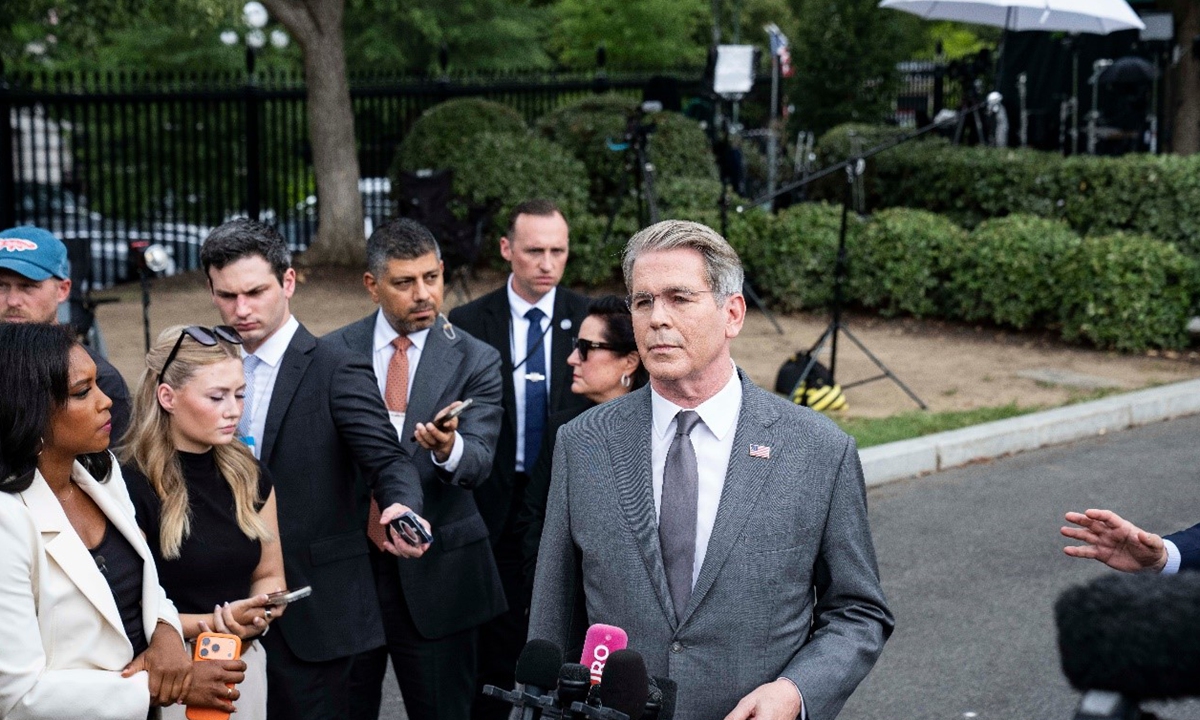
US Treasury Secretary Scott Bessent's latest remarks that Washington will impose "the toughest sanctions in history" on Iran while urging China to cooperate reflect an attempt to shift responsibility for the prolonged Iran war and the failure of US pressure tactics. By trying to drag China into the discussion, Washington is essentially resorting to the ploy of "making others take medicine for one's own illness." This amounts to the US' making excuses for its own erroneous policy toward Iran, said Chinese experts.
China opposes illicit unilateral sanctions that lack basis in international law and UN Security Council mandate, Lin Jian, spokesperson of the Chinese Foreign Ministry said on Friday in response to Bessent's remarks, calling on parties to act responsibly and stick to the political and diplomatic approach.
"We have the blockade (on Iran), and we are going to have the toughest sanctions in history," Bessent told CNBC. Bessent said he would hold a press conference on Monday to discuss details, according to a Reuters report.
When asked if the US could target China for doing business with Iran, Bessent said many conversations were best to have in private. "We are confident that everyone wants the Strait (of Hormuz) reopened, and for energy prices to come back down," he said, per Reuters.
Bessent's comments on Thursday followed US President Donald Trump's threat a day earlier of "Economic Warfare" and warning of economic consequences against any country that provided "any type of lifeline to Iran," according to Reuters.
The US appears to have reached an impasse with Iran, caught in a dilemma in which it can neither secure a military victory, reach a political settlement, nor easily disengage. Against this backdrop, Washington is seeking to intensify economic pressure on Tehran to force concessions, while also directing pressure toward China. At its core, this approach amounts to waging an economic cold war against Iran in an attempt to compel Tehran to alter its existing policies, Sun Degang, director of the Center for Middle Eastern Studies at Fudan University, told the Global Times on Friday.
Amid declining domestic support for the US' current policy on Iran, Bessent sought to shift blame onto others, a clear case of buck-passing. By blaming normal trade between Iran and countries such as China and Russia for the prolonged Iran crisis and the failure of Washington's pressure campaign on Iran, the US is "asking others to take medicine for its own illness." The root cause lies in Washington's own confrontational policy toward Iran, said the expert.
At a press conference of the Chinese Foreign Ministry on Thursday, a Bloomberg reporter asked: "US President Donald Trump has announced plans to inflict what he calls an 'economic D-Day' on Iran, including threats against Iran's trading partners. Given that China buys a large amount of Iranian oil, does the Foreign Ministry have any comment on this approach of economic warfare that Trump is threatening and how it might affect China?"
Spokesperson Lin said that sanctions and pressure tactics are not the solution. China calls on all parties to act responsibly and remain committed to a political and diplomatic approach.
Iranian Foreign Minister Abbas Araghchi described the US move as a "diversion from America's own crisis: unprecedented debt & surging interest costs." "Doubling down on failed policies will only bring further defeat - and enmity of Iranians. US economic terrorism threatens global economy and sovereignty worldwide," Araghchi wrote on X on Thursday morning.
The US has sanctioned Iran for decades without achieving its desired results. During the maximum economic pressure campaign launched in 2018, Iran suffered a severe economic downturn, yet Washington failed to force Tehran into major concessions. A new round of tougher sanctions could further strain Iran's economy and disrupt trade with regional partners, but is unlikely to trigger an immediate collapse, Tian Wenlin, a professor at the Renmin University of China's School of International Studies, told the Global Times.
Washington also appears to be taking a dual-track approach toward China: seeking to use China's economic leverage over Tehran while threatening Chinese companies that continue normal trade with Iran, said the expert.
Washington's shift from military options to economic pressure may signal limited de-escalation, but the broader US-Iran rivalry could settle into a prolonged, low-intensity standoff. Persistent tensions around the Strait of Hormuz would keep global energy markets under pressure, fueling inflation and weighing on global growth, said the expert.
Oil prices rose to more than a three-week high on Thursday following those US threats of financial penalties aimed at forcing an end to a nearly six-month-old war that has stranded millions of barrels of Middle Eastern oil, according to a Reuters report on Friday.
。
Current article:http://lgos9.shangfochengcongshuaizhuang.buzz/9gn2/pbf.html
Published on:08:15:10